

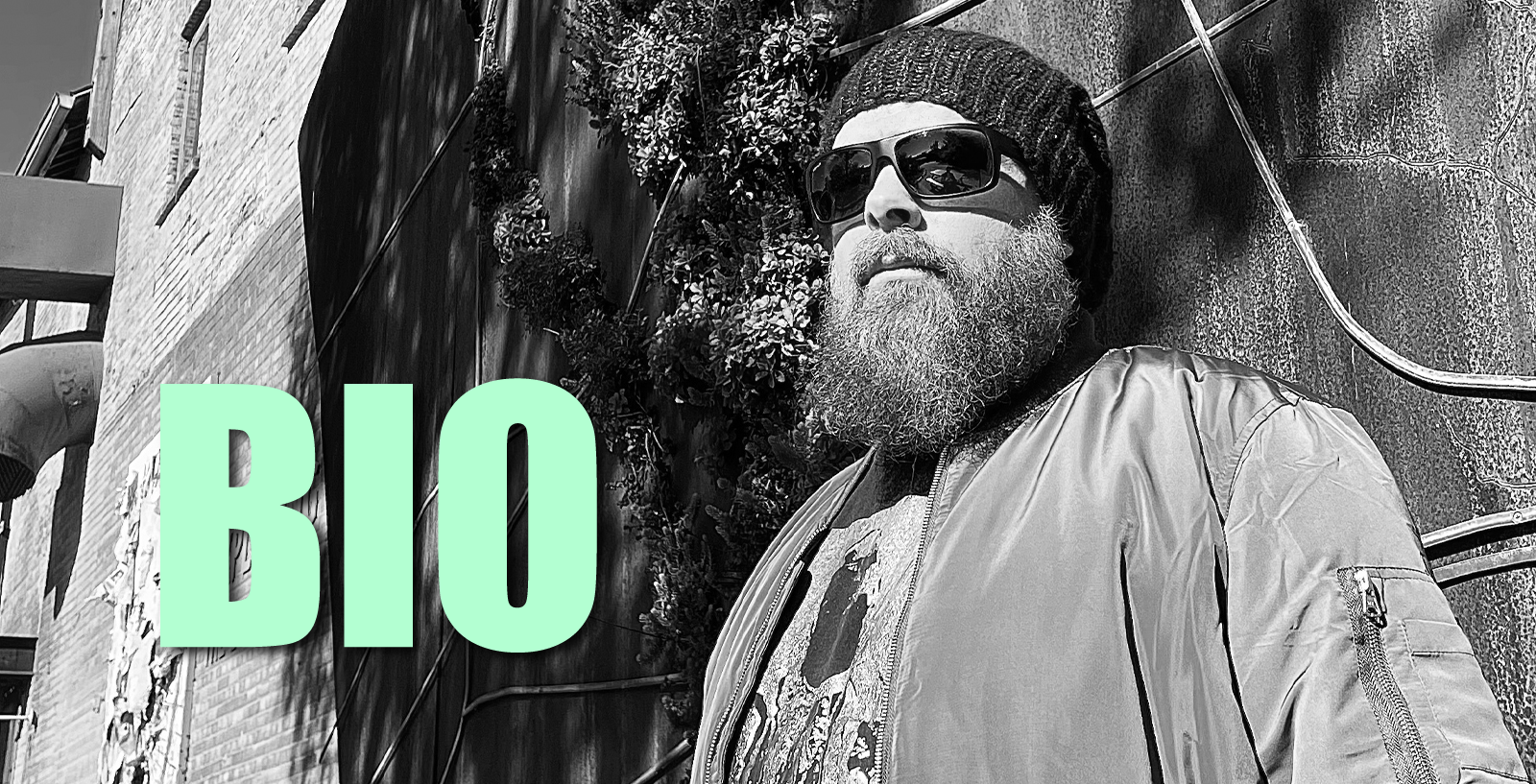
Canadian contemporary artist Kirk Purdon (b. 1974, Toronto, Canada) brings over two decades of rigorous practice, technical disruption, and conviction to his visual language. A product of the ground-breaking, specialized 3D animation program developed between Seneca Polytechnic and York University in the mid-1990s, Purdon was a classically trained visual artist mastering the digital frontier at a time when traditional galleries widely dismissed digital workflow. This unique background ignited a lifelong fascination with the translation between analogue craft and the digital matrix, forming the bedrock of his practice today.
An intense commitment to physical craft and studio resistance marks Purdon’s career. Having spent years developing his series of paintings, he developed a deep reverence for the technical friction, unpredictable chemistry, and manual struggle required to create a soulful image. In a modern culture obsessed with convenience, Purdon views the contemporary art landscape as trapped in “The Frictionless Aesthetic”, a sterile paradigm where artists use software grids, Photoshop mockups, and projectors to flatten digital layouts onto canvas.
In direct revolt, Purdon pioneered his signature Maximum Friction technique. Instead of using digital tools to effortlessly plan and lay out a work, his studio process operates in reverse. He begins on canvas, utilizing decades of professional intuition to chase raw, manual “moments”—the chaotic, organic textures and fracturing paint layers that a computer could never naturally simulate. Using LiDAR scanning and medium format digital photography, he extracts this high-friction human “aura” as primary visual data, mapping it onto custom three-dimensional morphologies via heavy GPU rendering engines to output variable, 1-of-1 masterworks.
Spanning painting, sculpture, and digital hybrids, Purdon’s evolving series reveal an unmistakable visual language where each body of work subtly informs the next. Drawing from art historical influences like Titian, John Constable, and Jan Van Eyck, alongside pop and street art pioneers Andy Warhol and Jean-Michel Basquiat, his work carries a street-level energy and dynamic intensity that is never mere surface. Beneath his vibrant colors and reflective forms lies a sharp undertone, often sinister, punctuated by haunting memento mori skull imagery that probes themes of mortality, transformation, and society’s shift from physical labor to a machine-mediated economy.
“When you see my work,” Purdon says, “I want it to feel like you were hit by a baseball bat.”
His pieces function like transponders, transmitting emotions, tensions, and complex questions for others to pick up on their own terms. For the casual observer, the experience is kinetic and striking. For the contemporary, post-internet collector who engages more deeply, his work rewards the curious. Purdon’s work offers a sophisticated space to witness the raw aura of human labor trapped inside a flawless digital matrix.
Purdon’s studio is based in Toronto, Canada, and his work is held in private collections around the world, including among celebrities, athletes, and prominent cultural figures. Regardless of scale, his goal remains constant: to create art that speaks with conviction, explores with maximum honesty, and challenges both artist and viewer to see—and feel—more.